Posts
Posts


This past week, comedian Kathy Griffin received much criticism and lost numerous business contracts due to a video she posted of her holding up a fake severed head made in the likeness of Donald Trump. Many people on both the political Right and Left (rightfully) condemned Griffin's actions. Trump himself tweeted about how the images were disturbing to his children, especially his 11-year old son.
 |
| Kathy Griffin and Donald Trump |
However, for anyone paying attention, much of this criticism seems a bit hypocritical because Griffin's video is merely the symptom of a larger problem in our society. Were the images Griffin posted offensive and disgusting? Definitely. But, it's also disgusting how often we tolerate such violence on behalf of our political party or our nation.
The truth is violence has always been embedded in American culture. Our nation was forged in the fires of violent revolution, and ever since then we have found ways to sacralize the myth of redemptive violence. We even have national holidays that strip away the ugliest parts of war and serve the public a cleaner version of "honor" and "valor." Looking at our history, we not only spend the most of any nation on our military (more than the next 8 nations combined or about 37% of the world's total military spending), but our country has also been at war for 224 of our 241 years of existence. We truly are a military-warrior nation.
But violence not only permeates the national stage, it also infects our homes. In American, 1 out of 4 women and 1 in 7 men will experience severe physical violence from an intimate partner or loved one at some point in their lives. Furthermore, this is not just a problem for any single demographic. Domestic violence cuts across all demographic markers--rich/poor, all ethnicities and races, urban/rural, educated/uneducated.

We even see violence infecting the world of sports. Much good work has been done recently on sports and the "warrior culture" within athletics that often fosters violence. Athletes, especially males, approach games as "battles," wear UnderArmour, and celebrate hyper-masculinity. Fans likewise get into the action wearing body paint like warriors, organizing themselves into tribes, and cheering on the events below. Some sports, such as football and hockey, have violence inherently built into the game. And who doesn't love to see a good hit or tackle in these sports? Sure, we might criticize the Romans for their gladiatorial games, but is the heart of our celebrations of violence in our arenas (and the insane amount of money we throw at them) really all that different simply because it's less bloody?
The point is, we cultivate a culture of violence everyday. We could go on to mention other examples. Violent video games, violent movies, violent language, gun culture, news that highlights murders and terrorism. This is the air we breathe and the water we drink.
So, it's no surprise that violence has infected our political rhetoric as well. Kathy Griffin was not the first, but simply the most recent example. Some of Griffin's most fervent critics were Trump's own supporters. However, there's a certain hypocrisy in this as these same individuals often tolerated (and sometimes endorsed) the violent discourse used by Trump during his candidacy. Trump frequently talked about assaulting protesters, argued we should kill even the wives and children of terrorists, and had to deal with a video where he bragged about sexual assault. Trump's violent rhetoric has spurred violence among some of his supporters as well, with one judge even stating Trump may be partially to blame for violence at his rallies.
And Trump isn't the only politician to talk about or use violence in recent months. During the campaign season, Joe Biden made remarks about wanting to "take [Trump] behind the gym," an allusion to physical violence not all that different from Trump's drooling over the "good 'ole days" when you could "just punch" someone you didn't like. Just late last month, a Republican congressional candidate was cited for assaulting a reporter just a day before the election. And yet, such violence did not seem to bother voters as he still managed to win his congressional seat. Likewise, following Trump's victory in November, a number of anti-Trump protesters started violent riots.
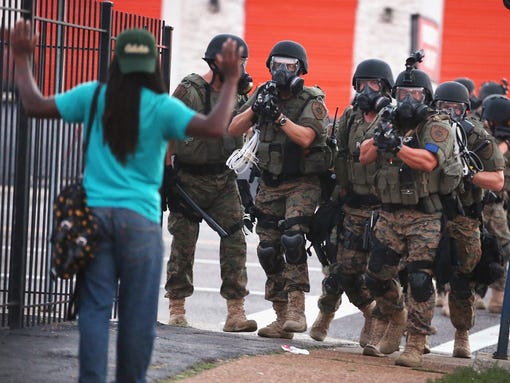
As we examine the use of violence in our political discourse, it's evident that violence is a problem for both sides of the aisle. This is because violence begets more violence. We see this phenomenon over and over. Police brutality and violence spurs violent riots. Wars against terrorism fuels more terroristic extremism. As Jesus said, "Those who live by the sword, die by the sword."
But, an interesting fact is that such violence in political discourse is not altogether new. Despite the fact that many feel like our country and our politics are going up in flames, the truth is we've always had violence in our politics. As mentioned earlier, our country's very inception was in violent revolution and rhetoric. And, throughout American history, our politics and political figures have always been marred by assaults and assassinations. We've even fought a war among ourselves over political differences.
 |
| In 1856, Senator Preston Brooks assaulted Sen. Charles Sumner in the U.S. Senate building. |
Why is this? I suspect it is for the reasons given above--that we are a culture surrounded by violence and in love with violence. Such violence tends to become more extreme when we also throw in the forces of political polarization and hyper-masculinity/patriarchalism, but the seeds of violence are always there because it's embedded in our culture's DNA.
For Christians, this should be disconcerting as followers of a man who preached "blessed are the peacemakers" and who demonstrated that the way to overcome evil is not through utilizing violence, but through compassionate sacrifice.
To overcome this culture of a violent political discourse, Christians cannot wait on their politicians. We must start this work themselves. We must begin to replace the myth of redemptive violence with the truth of sacrificial love. We must listen more to the values of the Kingdom of God rather than to the values of the nation of America. We must heed the words of peace from our Lord and Savior, rather than the siren call of strength and power offered by our culture.
Calling out the violence of the "other side" is not good enough and often just feeds polarization. We must be willing to also name violence within our own tribe and party. And even harder, we must be willing to take a hard look at our own lives and confess the ways in which we participate, tolerate, and advocate violence in our day to day routines. Most of us don't assault others, but we do all fetishize violence in various forms, benefit from war, have misaligned concepts of "justice," use violence or aggressive language, and otherwise allow violence to sneak into our lives in countless other ways. Until God's people can learn to be a "people of peace" and teach others to do the same, we will continue to see (and support) a violence political discourse.